The Memocept ingredients are a short list of nitric-oxide amino acids plus two supporting micronutrients: L-arginine, L-arginine alpha-ketoglutarate, L-citrulline HCl, L-citrulline malate, beta-alanine, niacin (vitamin B3), and calcium. Every amount is printed on the Supplement Facts label — there is no hidden "proprietary blend," and there is no caffeine or stimulant in the formula. This page breaks down each of the Memocept ingredients, the exact dose per capsule, and what the published research does and does not show. We are an independent review resource, not the seller, so the goal here is a straight, complete read of the label — every dose in plain sight, backed by the published research.
What's on the Memocept Supplement Facts label
Memocept lists seven active ingredients on its Supplement Facts panel, taken as one capsule per day (30 capsules per bottle). Six of the seven push the same lever — nitric oxide production and blood flow — while niacin and calcium play supporting roles. Here is the full label, ingredient by ingredient:
| Ingredient | Amount per capsule | Stated role |
|---|---|---|
| Niacin (vitamin B3) | 7.5 mg NE (47% DV) | Energy metabolism, nervous system |
| Calcium (as carbonate) | 18 mg | Cell signaling / neurotransmission |
| L-Arginine | 200 mg | Nitric oxide precursor |
| L-Arginine alpha-ketoglutarate (2:1) | 200 mg | Absorption-friendly arginine form |
| L-Citrulline HCl | 100 mg | Converts to arginine; sustained nitric oxide |
| L-Citrulline malate | 100 mg | Circulation and energy |
| Beta-alanine | 40 mg | Endurance; focus under fatigue |
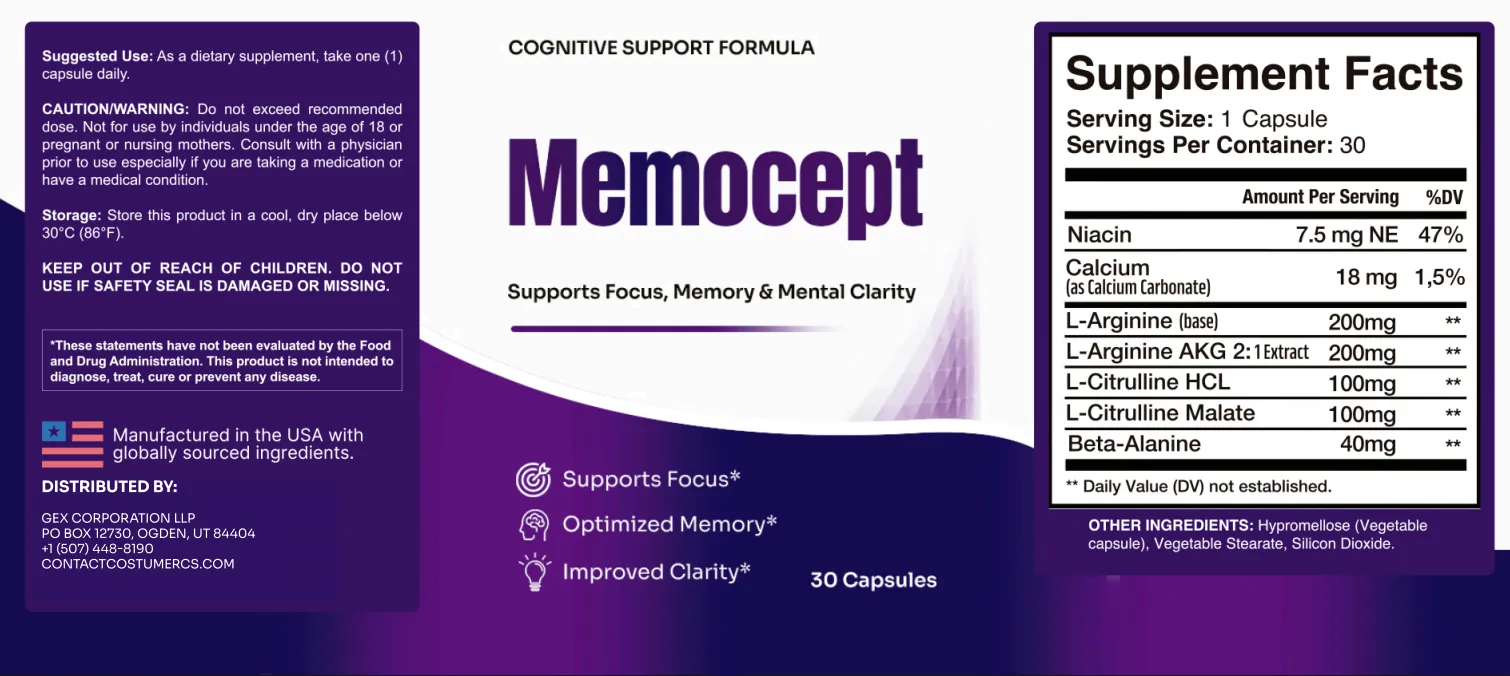
The panel is fully disclosed, which is a point in Memocept's favor — plenty of "brain" supplements bury their doses inside a proprietary blend so you can't see how little of each ingredient you're getting. Here, every milligram is on the label. You can cross-check the current panel yourself on the official Memocept website before you buy, since manufacturers do occasionally reformulate.
The nitric oxide idea behind the Memocept formula
Almost all of the Memocept ingredients are built around one mechanism: raising nitric oxide. Nitric oxide is a molecule the body makes from the amino acid arginine, and its main job is to relax the lining of blood vessels so they widen. Wider vessels mean easier blood flow, including flow to the brain. The logic Memocept runs on is that better cerebral circulation supports focus, clarity, and memory.
This is also why the formula tends to be marketed to people over 45: blood flow to the brain generally becomes less efficient with age, so circulation-focused supplements target that decline rather than a specific disease. That makes cerebral circulation one of the most logical levers to support as you age — which is exactly the pathway Memocept is designed to target.
Because it works upstream on blood flow, Memocept is built around the very mechanism the published circulation research points to. It's designed to support focus, clarity, and the kind of day that simply runs smoother — through better cerebral blood flow rather than stimulants.
What each Memocept ingredient does
Below is each ingredient, the dose Memocept uses, and the published research behind it, with each study linked so you can read the abstract yourself.
L-arginine and L-arginine AKG (400 mg combined)
L-arginine is the headline ingredient, at 200 mg, with another 200 mg supplied as L-arginine alpha-ketoglutarate — a 2:1 form the maker includes for absorption. The body uses arginine to synthesize nitric oxide, which widens blood vessels. One frequently cited trial reported that L-arginine raised cerebral blood flow by roughly 9.5% (PMID 9119904). That study confirms the mechanism arginine runs on — and it's why arginine is Memocept's headline ingredient, included at a clearly labeled 200 mg, with another 200 mg in the absorption-friendly AKG form for a gentle, everyday daily dose.
L-citrulline HCl and L-citrulline malate (200 mg combined)
Memocept pairs 100 mg of L-citrulline HCl with 100 mg of L-citrulline malate. Citrulline is interesting because the body converts it back into arginine, and it can raise nitric oxide more steadily than arginine taken on its own (PMID 28336910). The malate form has been studied for circulation and exercise energy (PMID 32824588). Memocept keeps citrulline at gentle, everyday amounts — 200 mg in total, printed right on the label — paired with the arginine so nitric oxide stays topped up through the day.
Beta-alanine (40 mg)
Beta-alanine is best known in sports nutrition for buffering muscle fatigue. A smaller line of research has looked at whether it supports mental performance under stress or tiredness (PMID 27749691). Memocept adds a gentle 40 mg as a supporting touch, rounding out the nitric-oxide core rather than overpowering it — a clearly labeled amount, not a hidden blend.
Niacin (vitamin B3) and calcium
The formula rounds out with 7.5 mg of niacin — vitamin B3, at 47% of the Daily Value — and 18 mg of calcium as carbonate. Niacin supports normal energy metabolism and nervous-system function (PMID 31142457), and calcium plays a role in cell signaling and neurotransmission. Niacin is also a mild vasodilator on its own, which fits the blood-flow theme of the rest of the formula. Both are included at gentle, everyday amounts, clearly labeled — with niacin's own mild vasodilation reinforcing the blood-flow theme that runs through the whole formula.
Why the Memocept doses make sense
Every Memocept ingredient is printed at a transparent, everyday dose — no proprietary blend, nothing hidden. The formula is built to be taken once a day, so the nitric-oxide amino acids work together and the effect builds with consistent daily use. Because arginine and citrulline gently support healthy blood flow, it's worth a quick word with your doctor if you take blood-pressure, heart, or ED medication — we cover that on Memocept side effects. And we weigh the whole picture, including real user feedback and value, in our full Memocept review.
Other (inactive) ingredients in Memocept
Beyond the seven actives, Memocept's label lists three inactive ingredients: hypromellose, vegetable stearate, and silicon dioxide. Hypromellose is the plant-based capsule shell, which makes the product suitable for vegetarians. Vegetable stearate is a flow agent that keeps the powder from sticking during manufacturing. Silicon dioxide is a common anti-caking agent. None of the three add an effect — they exist to hold the capsule together and help it fill consistently.
Notably absent from that list: caffeine, artificial stimulants, and any undisclosed "blend." What you see on the panel is what you get.
Frequently asked questions about Memocept ingredients
What are the ingredients in Memocept?
Memocept contains seven active ingredients: L-arginine (200 mg), L-arginine alpha-ketoglutarate (200 mg), L-citrulline HCl (100 mg), L-citrulline malate (100 mg), beta-alanine (40 mg), niacin/vitamin B3 (7.5 mg), and calcium (18 mg). It also uses three inactive ingredients — hypromellose (the vegetable capsule), vegetable stearate, and silicon dioxide. The supplement is taken as one capsule per day, 30 capsules per bottle.
Does Memocept contain caffeine or stimulants?
No. The Memocept Supplement Facts label lists no caffeine, guarana, or other stimulants. Its ingredients work through the nitric-oxide and blood-flow pathway rather than by stimulating the nervous system, so it should not produce the jittery lift or crash you get from a caffeinated nootropic. That also means it won't feel like an obvious "buzz" — the intended effect is subtler.
Are Memocept ingredients backed by research?
Yes. The Memocept ingredients — especially L-arginine and L-citrulline — are backed by published research linking them to nitric oxide and healthy blood flow, and you can read those studies on PubMed. Memocept brings them together at transparent, clearly labeled doses in a caffeine-free, once-daily capsule designed to support focus and mental clarity through better cerebral circulation.
As an independent review resource — not the official seller — our aim is simply to lay out the Memocept ingredients honestly so you can decide for yourself. If you'd like to see the current label straight from the source, visit the official Memocept store.
This article is for informational purposes only and is not medical advice. Memocept is a dietary supplement, not a treatment for any disease, and these statements have not been evaluated by the FDA. Talk to your doctor before starting any supplement, especially if you take medication or have a health condition.